“Hello, how are ye?”, the young man said, perhaps a little awkwardly. “I’m staying next door, and they sent me in to ask if we could borrow a cup of sugar”. “Ye can of course – just hold on there a minute and I’ll get it for ye.” Mrs. Mythen replied. She went out to the kitchen, leaving the young lad standing there feeling decidedly nervous in the company of two rather attractive young ladies.
Mrs. Mythen had four daughters, Bridie, Kathleen and twins May & Dorothy, as well as a son, Sean, all of whom she had raised by herself since her husband had passed away in 1942 when the twins were only five years old. A fifth daughter – the first born – Rita, had died in childhood, before the twins were born. But it was the mid 1950’s now and the twins were young women of 18 or 19, and both of them were sitting there, sewing dresses and discreetly observing this somewhat handsome newcomer.
They weren’t identical twins, in fact they could scarcely have looked less alike, with May’s dark hair and deep brown eyes contrasting with Dorothy’s fair hair and sparkling blue eyes. The visitor, Philip, thought they were both very attractive girls, which indeed they were. The Mythen twins had no shortage of admirers in the small County Wexford village of Blackwater. But his eye was magnetically drawn to the fair Dorothy. The silence in the room was deafening and he had to think on his feet to start a conversation.
“Ehm…what’s that ye’re sewing?” he asked, as if the answer wasn’t in plain sight! “Our dresses for the dance on Saturday”, replied Dorothy with a slight giggle. This was good – the question had been deliberately directed at both of them, but the reply came from the desired party. “Oh – there’s a dance on is there?” he said. He seemed to be developing a gift for asking questions to which he already knew the answer. What was needed here was for one of the girls, ideally Dorothy, to get him off the hook by asking HIM a question. “Do you dance?” she looked up from her sewing, straight into his eyes. His heart was in his throat now. “Ehm – oh I do yeah!” he said, just a shade too loudly. “I love the dancing. I go to the Olympia Ballroom all the time!” This was true. He was quite an accomplished ballroom dancer, and had medals to prove it – but best not to mention that at this stage. It would seem boastful – and Philip was not a boastful man. “Where’s that now, the Olympia?” Now May was asking the questions. He was thrown for a second. “Huh? Oh! It’s…ehhm…at home!”. They stared at him. “I mean in Waterford. The Olympia is in Waterford. That’s where I’m from.” They glanced at each other briefly – a knowing glance that he didn’t catch. “So”, Dorothy again now, “You’re one of the wiremen, are you?”. “I am” said Philip “I’m the RAO”. Dorothy smiled inwardly to herself. The RAO no less – not just any wireman. And he’s staying right next door. Philip also smiled inwardly to himself. He could sense that he had made an impression.
For the first half of the twentieth century, only the larger towns and cities in Ireland had electricity. Once you got out into the countryside, life in the villages and on the farms was very different. Homes were lit with candles and kerosene lamps. For most, there was no running water, just a well with a hand pump and, of course, no TV or radio, unless you could afford one of those huge battery-operated valve radios. Beginning in 1946, the government of what was then still a fledgling republic embarked on a massive project to bring the entire country into the modern era by bringing electricity to the rural people – village by village, parish by parish and farm by farm. It took a while – the last village was connected in 1964, but The Rural Electrification Scheme was a success thanks to the thousands of workers employed by the State-owned Electricity Supply Board. They worked in “gangs”, made up of linesmen, semi-skilled and locally recruited general workers, and each gang would move from place to place, erecting poles and pylons across the landscape, wiring up each village as they came to it, before performing the Switching On Ceremony in the village hall and moving on to the next township. For the duration of the job, the ESB workers would stay in the homes of local families, and before long they became known as “the wiremen”.
However, before any of this could happen, they had to send people around the country persuading the locals to actually sign up for “The Electric” as it was known. Only when a certain quota of people in the area had agreed to sign up could the gangs then move in and do the job. These pathfinders were known as canvassers and their task was by no means easy – there was some resistance to the scheme in the early days, until people realised how much it would benefit them. Demonstrating home appliances like electric kettles and washing machines to the housewives of Ireland proved a crucial factor in overcoming this. Farmers were persuaded by something simpler – the outside light in the farmyard meant that work on the farm no longer had to stop when it got dark, which is around 4.30pm in the long Irish winter.
Philip Cox joined the E.S.B. in Waterford, straight out of school at 18. He was assigned to the rural south east of the country. One of 792 rural areas of the scheme, it covered a considerable amount of territory across South Kilkenny and parts of County Wexford. He canvassed the entire area on a bicycle over the summer of 1953, which is still spoken of today as one of the greatest summers Ireland ever enjoyed. He also had to go around the countryside persuading farmers to allow the E.S.B. to run the cables over their land, on poles and pylons. He would then cross the county on foot, marking out the spots in each field where the poles were to be erected by the gang following behind him. In time, he was promoted and became the Rural Area Organiser (RAO), one of three key staff assisting the Rural Area Engineer. The RAO was the main point of contact with the public, and in addition to canvassing, would be involved in organising demonstrations, the sale of appliances, and helping to manage the gang who were working that locality. Eventually, around 1955, they came to the beautiful Wexford village of Blackwater. He set up his office in the village hall and moved into the home of a local family next door to the house where Mrs. Mythen and her children lived.
Twins Dorothy and May Mythen had grown up in Blackwater and had received secondary school education through a scholarship to the Loreto Convent, a boarding school for girls in Wexford Town. Dorothy then became a schoolteacher herself, and went back to Blackwater from where she would cycle ten miles each way to and from the village of Oilgate to teach in the local primary school there. Having gone to boarding school in the large town of Wexford, she was, of course, no stranger to the benefits of electricity and was quite pleased when the wiremen finally arrived in Blackwater. Even more so when it turned out that the RAO was a very handsome young man who rode a motorcycle and was staying next door. She often used to sit at the window in the evenings and watch – listening for the sound of a BSA Bantam engine heralding his arrival home from the day’s work.
“So, you’re staying next door you said?”. Good – keep going. Hopefully their mother will take a while to find the sugar. “That’s right. I’m the RAO on the Rural”. You already said that! “Will we just call you The RAO Next Door then or…..??”, that was May. “Oh, sorry yes, I mean no…ehm – Philip. Philip Cox, but everyone just calls me Phil”. “Well Phil, I’m May and this is Dorothy Mythen.” replied May. “But you can call me Dorrie!”, blurted out her sister. Phil mentally high-fived himself. “So, this dance – it’s on Saturday, is it?” He knew full well that it was on Saturday, even before they’d mentioned it – he always knew when and where there was a dance on – but it seemed wise to appear nonchalant. “It is yeah”, said Dorrie. “But you’re probably going home for the weekend, are you?” Phil paused for a second or two. “Ehm, no…no I’m not. It’s a bit far to ride just for a weekend.” It wasn’t – not when you’re riding a motorcycle. “Here’s your sugar now. Tell her there’s no rush on returning it at all.”, Mrs. Mythen broke the spell and the music playing in Phil’s head scratched to a halt like an old gramophone which had wound down. “Oh, ehm thanks…thanks very much Mrs. Mythen. I’d better be off then. Nice to meet you all!” and with that, he bolted out the door. “Maybe we’ll see you at the dance, so!” Dorrie called after him.
Mrs. Mythen looked from one twin to the other quizzically, finally settling on Dorrie. “How did he know my name?” she asked. Dorrie blushed and said “May told him!”
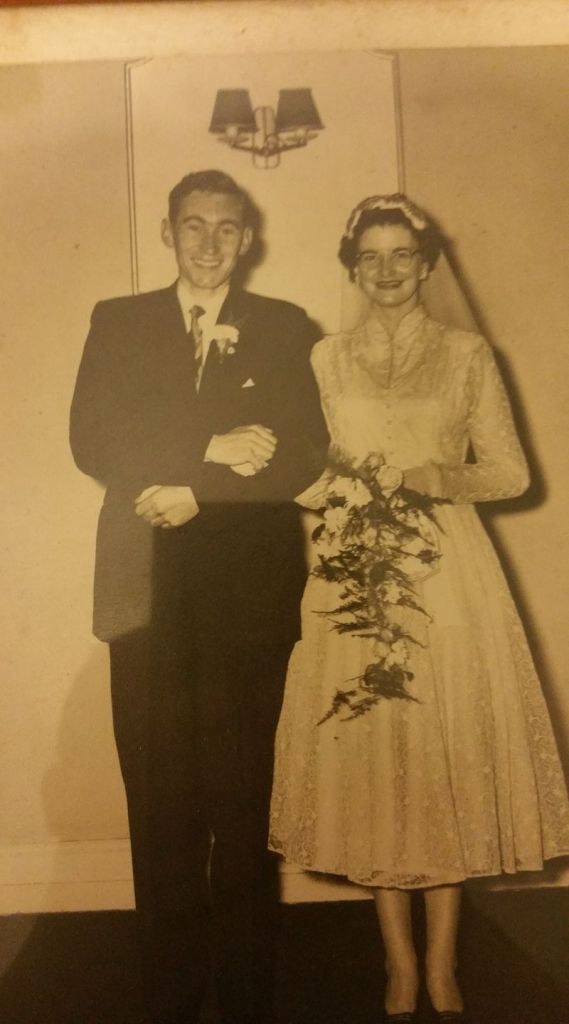
Phil did attend that dance on the village green, and many others after it with Dorrie on his arm. He returned to Blackwater frequently long after his gang had moved on, for the village wasn’t the only thing to have been lit up that year. He and Dorrie were married in St. Brigid’s Church, Blackwater on July 15th 1958. After moving around a bit with the ESB, they eventually settled in Waterford and raised five children. Phil remained with the ESB until he retired in 1993.
In February 2001, after almost forty three years of marriage, a heartbroken Dorrie stood at Phil’s graveside and placed a single rose on his casket, along with a hand written note – “Until we meet again, your Dor”. On April 24th 2022, four days after her 85th birthday, Dorrie finally did go to meet her RAO again, bringing their 65-year earthly love story full circle, and starting their eternal dance together.
We, their children, are now the heartbroken ones, but we will carry on and do our best to pass on what they taught us to their grandchildren and great-grandchildren, for we five are truly privileged to have had such people as our parents.
Rest In Peace Dorrie & Phil.
GM 26th April 2022

 Ger Mythen
Leave a reply to Peter McGrath Cancel reply